• Embedded
    modules.

    MKC | Development | Assembly: in-house | Embedded Modules

Our pluggable and solderable embedded module series brings network know-how to your device.

In the simplest case, all you need is a carrier board on which your task and the power supply for the modules are implemented. The use of the interfaces available from the module (Ethernet, USB, SPI, I/O, etc.) reduces the requirements for the layout of the carrier board to a minimum and you can concentrate on your actual core competence.

The modules are designed for different performance requirements and, with different equipment variants, serve as a computer unit for a wide range of control, automation and data communication tasks. This not only saves your development budget but also considerably shortens your time-to-market for the overall solution.

Other products:

MKC | Development | Assembly: in-house | IoT

eNetMaxi.

MKC | Development | Assembly: in-house | eNetMaxi

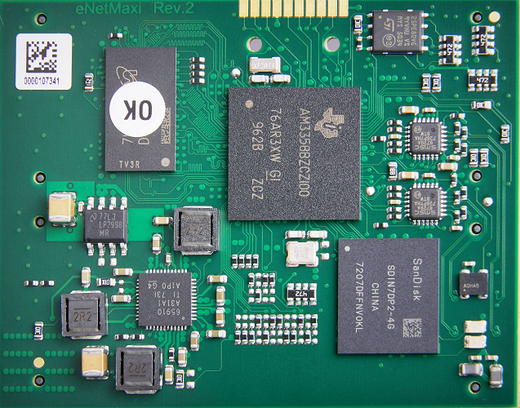
The ARM Cortex-based embedded module is a high-performance, fully tested System-on-Module (SoM) solution for control, automation, and data communication applications. The integrated network interface—including optional Power over Ethernet (IEEE 802.3af)—and the offloading of complex high-speed signal routing to the module significantly reduce development effort and time to market. The modules, developed and manufactured by MKC, also enable custom hardware and software adaptations as well as the implementation of customer-specific OEM solutions.

With the module based on an ARM Cortex A8, we offer you a professional component to implement sophisticated control, automation and data communication tasks.

With the eNetMaxi you get a complete microprocessor system for a Linux system that, in conjunction with a carrier card, makes USB ports, serial interfaces, SD cards and the network connection up to the RJ45 socket available ‘on-board’.

  • ARM Cortex-A8, 1GHz
  • 512MB DDR3 RAM
  • 4GB eMMC FLASH
  • 16MB SPI-FLASH
  • 16 Bit GPMC-Bus
  • Timer, Interrupts
  • RTC, Watchdog

Interfaces
Many of the CPU’s interfaces are routed to the carrier card and can be used to implement serial interfaces (UART, SPI, I2C), USB ports, SD cards or digital inputs/outputs. It is also intended to be used as an address and data bus (GPMC) to connect external peripherals (FPGA).

Dimensions
Because of its extremely small dimensions of just 47 mm x 60 mm, the eNetMaxi is ideal for integration into very small devices.

Safety
To meet industrial requirements, the module can be soldered directly to the carrier board using standard post connectors. Independently of this, the module can be plugged in for laboratory use.

CAD
Libraries for various CAD systems, such as Altium Designer, are available to make it easier to integrate the eNetMini into your own projects.

Long-term availibility

We guarantee a long-term availability of the module of at least 5 years.
Thanks to our own development and production facilities in Wuppertal, compatible successors can be realized beyond this period.

The MKC1502 carrier card is a reference design for the embedded module eNetMaxi. With this carrier card and our Linux Distribution (BSP) we offer you an easy introduction to your application development under Linux.

The supply is via an 18…48 V supply or, directly via the network with PoE.

Ports

Many interfaces of the eNetMaxi module are routed to the carrier card and can be used to implement various interfaces (UART, SPI, I2C, CAN, USB, RTC, PWM) or digital inputs/outputs.

  • Serial interface (USB, FTDI)
  • 2 Networkports 100 MBit (RJ45, Poe)
  • uSD-Kartenfassung
  • USB-Master (Type A)
  • USB-OTG (microUSB-AB)
  • LED
  • Sensor for temperature and humidity

Dimensions
The carrier card is installed in our embedded device eNetVario, for which corresponding Linux BSPs are available.

On this page, you’ll find everything you need to know about our eNetMaxi modules.

Price upon request. Please understand that we only ship to new customers upon receipt of payment in advance.

Order number Description
eNetMaxi.STD eNetMaxi module
eNetEval.1502.STD MKC1502 carrier card with fitted eNetMaxi module

The explanations about the communication and parameterization of our devices, the JSON-REST API used and the description of the homepage are available directly in our online documentation.

Manuals, data sheets, instructions and the latest software/firmware can be downloaded below

eNetMaxi Data Sheet (DE)

eNetMaxi Technical Manual (DE)

eNetMaxi Software Manual (DE)

eNetEval.1502 Product description (DE)

MKC.1502 Manual (DE)

Linux Software Manual (DE)

The software components used in the eNetMaxi module are subject to certain licenses. The components used and their associated licenses are listed below.

MKC

The widely used MIT license is used for the software created by MKC Michels & Kleberhoff. This applies both to the finished, closed-source application of the module and to the freely accessible (open-source) source code, which is available as examples for your own applications.

Copyright (c) 2018-2024 MKC Michels & Kleberhoff Computer GmbH

All rights reserved.

Permission is hereby granted, free of charge, to any person obtaining a copy of this software and associated documentation files (the “Software”), to deal in the Software without restriction, including without limitation the rights to use, copy, modify, merge, publish, distribute, sublicense, and/or sell copies of the Software, and to permit persons to whom the Software is furnished to do so, subject to the following conditions:

  • The above copyright notice and this permission notice shall be included in all copies or substantial portions of the Software.

THE SOFTWARE IS PROVIDED “AS IS”, WITHOUT WARRANTY OF ANY KIND, EXPRESS OR IMPLIED, INCLUDING BUT NOT LIMITED TO THE WARRANTIES OF MERCHANTABILITY, FITNESS FOR A PARTICULAR PURPOSE AND NONINFRINGEMENT. IN NO EVENT SHALL THE AUTHORS OR COPYRIGHT HOLDERS BE LIABLE FOR ANY CLAIM, DAMAGES OR OTHER LIABILITY, WHETHER IN AN ACTION OF CONTRACT, TORT OR OTHERWISE, ARISING FROM, OUT OF OR IN CONNECTION WITH THE SOFTWARE OR THE USE OR OTHER DEALINGS IN THE SOFTWARE.

Debian (Linux)

Many of the programs in the system are licensed under the GNU General Public License, often simply referred to as “the GPL”.

The GPL requires that the source code of programs be made available whenever a binary copy of the program is distributed; This provision of the license ensures that every user has the ability to modify the software. Due to this provision, the source code for all such programs is available in the Debian system or upon request.

At “www.debian.org” you will find good and detailed information about the source code and the associated licenses.

eNetMini.

MKC | Development | Assembly: in-house | eNetMini

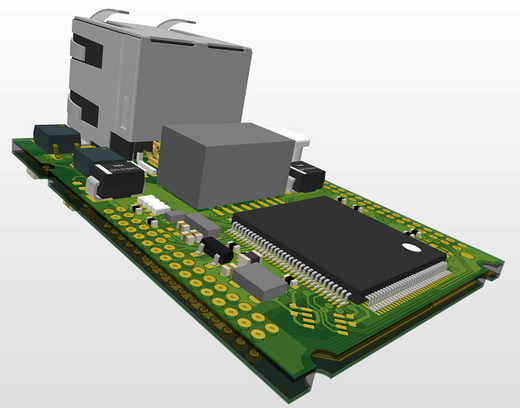
The eNetMini is an ARM Cortex-based system-on-module (SoM) for control, automation, and data communication applications. With its integrated network interface featuring an RJ45 jack and optional Power over Ethernet (PoE) support (IEEE 802.3af), the module simplifies hardware development and reduces the effort required for signal routing on the carrier board. As a fully tested embedded system, it shortens development time and can be flexibly deployed on various carrier boards. Thanks to MKC’s in-house development and manufacturing capabilities, customer-specific hardware and software customizations, as well as the implementation of individual OEM solutions, are also possible.

The module has the network connection ‘on-board’ up to the RJ45 socket. In the POE version, power can be supplied to the carrier card and the module via the network (IEEE802.3af, Power over Ethernet).

This eliminates the need to implement complex high-speed cables on the separate carrier card.

All available connections of the eNetMini.1601 module are routed to the carrier card via solderable/pluggable pin headers in a 2 mm grid. It is therefore ideally suited to being soldered/plugged onto different carrier cards at a later date.

Module

  • 32 Bit ARM Cortex-M4, 120MHz
  • 256KB SRAM
  • 512KB FLASH
  • 6KB EEPROM
  • 128MBit SPI-FLASH
  • Network controller incl. cable interface

Interfaces
Many interfaces (24 I/Os) of the CPU are routed to the carrier card and can be used to implement various interfaces (UART, SPI, I2C, CAN, USB, RTC, PWM) or digital inputs/outputs. It is also intended to be used as an address and data bus to connect external peripherals (FPGA).

Dimensions
Due to its extremely small dimensions of just 30 mm x 44.5 mm, the module is ideally suited for integration into very small devices.

Security
To meet industrial requirements, the module can be soldered directly to the carrier board using standard post connectors. Independently of this, the module can be plugged in for laboratory use.

CAD
Libraries for various CAD systems, such as Altium Designer, are available to make it easier to integrate the eNetMini into your own projects.

Long-term availability
We guarantee a long-term availability of the module of at least 5 years.
Thanks to our own development and production facilities in Wuppertal, pink-compatible successors can be realized beyond this period

The firmware supplied with the eNetMini is immediately ready for use and functional, but can be adapted to the respective requirements using the Code Composer Studio (IDE, Texas Instruments). The easiest way to get started with your development is to use one of our eNetEval.1702.


The module has the network connection ‘on-board’ up to the RJ45 socket. In the POE version, power can be supplied to the carrier card and the module via the network (IEEE802.3af, Power over Ethernet).

This eliminates the need to implement complex high-speed cables on the separate carrier card.

All available connections of the eNetMini.1806 module are routed to the carrier card via SMD connections. It is therefore ideally suited to being integrated as an SMD component directly into the production process of the carrier board.

Many interfaces (42 I/Os) of the CPU are routed to the carrier board and can be used to implement various interfaces (UART, SPI, I2C, CAN, USB, RTC, PWM) or digital inputs/outputs. It is also intended to be used as an address and data bus to connect external peripherals (FPGA).

 Module

  • 32 Bit ARM Cortex-M4, 120MHz
  • 256KB SRAM
  • 512KB FLASH
  • 6KB EEPROM
  • 128MBit SPI-FLASH
  • Network controller incl. cable interface

Dimensions
Due to its extremely small dimensions of just 32 mm x 44.5 mm, the module is ideally suited for integration into very small devices.

Security
To meet industrial requirements, the module is soldered directly to the carrier board as an SMD component.

CAD
Libraries for various CAD systems, such as Altium Designer, are available to make it easier to integrate the eNetMini into your own projects.

Long-term availability
We guarantee a long-term availability of the module of at least 5 years.
Thanks to our own development and production facilities in Wuppertal, compatible successors can be realized beyond this period.

The firmware supplied with the eNetMini is immediately ready for use and functional, but can be adapted to the respective requirements using the Code Composer Studio (IDE, Texas Instruments). The easiest way to get started with your development is to use one of our eNetEval.1807.

The carrier card (MKC1702) is a reference design for the embedded module eNetMini.1601 and can be used for network-compatible I/O. All available signals are available on standard posts or directly via the associated connectors.

Power is supplied via a micro-USB socket or directly via the network with PoE for the future.

Interfaces

Many interfaces (24 I/Os) of the eNetMini.1601 module are routed to the device card and can be used to implement various interfaces (UART, SPI, I2C, CAN, USB, RTC, PWM) or digital inputs/outputs.

  • CAN
  • USB master (type A connector)
  • MicroSD socket (SPI)
  • BlueTooth module (Stolmann BlueMod+S/AI)
  • Serial interface (USB, FTDI)
  • Serial interface (RS232/485)
  • I²C temperature/humidity/pressure sensor
  • I²C brightness sensor
  • Network controller incl. cable interface (eNetMini.1601)

Dimensions
The carrier card measures 100 mm x 130 mm.

The carrier card (MKC1807) is a reference design for the embedded module eNetMini.1806 and can be used for network-compatible I/O. All available signals are available on standard posts or directly via the associated connectors.

Power is supplied via a micro-USB socket or directly via the network with PoE for the future

Interfaces

Many interfaces (42 I/Os) of the eNetMini.1806 module are routed to the device card and can be used to implement various interfaces (UART, SPI, I2C, CAN, USB, RTC, PWM) or digital inputs/outputs.

  • Serial interface (USB, FTDI)
  • Network controller incl. cable interface (eNetMini.1806)

Dimensions
The carrier card has dimensions of 100 mm x 105 mm.

On this page, you will find all eNetMini modules and evaluation boards.

Prices available upon request. Please understand that we only ship to new customers upon receipt of payment in advance.

Order Number Description
eNetMini.1601.STD MKC1601 module
eNetMini.1601.POE MKC1601 module with PoE functionality
eNetMini.1806.STD MKC1806 module
eNetMini.1806.POE MKC1806 module with PoE functionality
eNetEval.1702.STD MKC1702 Carrier card for one eNetMini.1601 module
eNetEval.1807.STD MKC1807 Carrier card with fitted eNetMini.1806.STD module
eNetEval.1807.POE MKC1807 carrier card with fitted eNetMini.1806.POE module (supply via PoE possible)

The software components used in the eNetMini module are subject to certain licenses. The components used and their associated licenses are listed below.

MKC

The widely used MIT license is used for the software created by MKC Michels & Kleberhoff. This applies both to the finished, closed-source application of the module and to the freely accessible (open-source) source code, which is available as examples for your own applications.

Copyright (c) 2018-2024 MKC Michels & Kleberhoff Computer GmbH

All rights reserved.

Permission is hereby granted, free of charge, to any person obtaining a copy of this software and associated documentation files (the “Software”), to deal in the Software without restriction, including without limitation the rights to use, copy, modify, merge, publish, distribute, sublicense, and/or sell copies of the Software, and to permit persons to whom the Software is furnished to do so, subject to the following conditions:

  • The above copyright notice and this permission notice shall be included in all copies or substantial portions of the Software.

THE SOFTWARE IS PROVIDED “AS IS”, WITHOUT WARRANTY OF ANY KIND, EXPRESS OR IMPLIED, INCLUDING BUT NOT LIMITED TO THE WARRANTIES OF MERCHANTABILITY, FITNESS FOR A PARTICULAR PURPOSE AND NONINFRINGEMENT. IN NO EVENT SHALL THE AUTHORS OR COPYRIGHT HOLDERS BE LIABLE FOR ANY CLAIM, DAMAGES OR OTHER LIABILITY, WHETHER IN AN ACTION OF CONTRACT, TORT OR OTHERWISE, ARISING FROM, OUT OF OR IN CONNECTION WITH THE SOFTWARE OR THE USE OR OTHER DEALINGS IN THE SOFTWARE.

TI-RTOS

Copyright (c) 2007-2024 Texas Instruments Incorporated

All rights reserved.

Redistribution and use in source and binary forms, with or without modification, are permitted provided that the following conditions are met:

  • Redistributions of source code must retain the above copyright notice, this list of conditions and the following disclaimer.
  • Redistributions in binary form must reproduce the above copyright notice, this list of conditions and the following disclaimer in the documentation and/or other materials provided with the distribution.
  • Neither the name of Texas Instruments Incorporated nor the names of its contributors may be used to endorse or promote products derived from this software without specific prior written permission.

THIS SOFTWARE IS PROVIDED BY THE COPYRIGHT HOLDERS AND CONTRIBUTORS “AS IS” AND ANY EXPRESS OR IMPLIED WARRANTIES, INCLUDING, BUT NOT LIMITED TO, THE IMPLIED WARRANTIES OF MERCHANTABILITY AND FITNESS FOR A PARTICULAR PURPOSE ARE DISCLAIMED. IN NO EVENT SHALL THE COPYRIGHT OWNER OR CONTRIBUTORS BE LIABLE FOR ANY DIRECT, INDIRECT, INCIDENTAL, SPECIAL, EXEMPLARY, OR CONSEQUENTIAL DAMAGES (INCLUDING, BUT NOT LIMITED TO, PROCUREMENT OF SUBSTITUTE GOODS OR SERVICES; LOSS OF USE, DATA, OR PROFITS; OR BUSINESS INTERRUPTION) HOWEVER CAUSED AND ON ANY THEORY OF LIABILITY, WHETHER IN CONTRACT, STRICT LIABILITY, OR TORT (INCLUDING NEGLIGENCE OR OTHERWISE) ARISING IN ANY WAY OUT OF THE USE OF THIS SOFTWARE, EVEN IF ADVISED OF THE POSSIBILITY OF SUCH DAMAGE.